Welcome to
EduSkills+ Media Toolbox for educators
The Media Education Toolbox offers guidance for educators who want to explore media education together with children and families in kindergarten. It brings together reflections, practical methods, and examples that support educators in creating meaningful learning experiences related to media.
Overview
Some sections provide background knowledge about media education in kindergarten, while others offer practical activities and methods for working with children. You will also find ideas for cooperation with parents and suggestions for reflection and discussion within your team.
What the Toolbox Includes

Background information on media education in kindergarten
Best-practice examples for working with parents and caregivers, including tested methods

Printable materials such as information sheets and other resources
Different Types of Activities
Some activities are designed for direct use with children. Others invite educators to observe, reflect, and discuss their educational practice with colleagues. These reflective elements support thoughtful and age-appropriate media education.
Four Steps for Developing Media Education in Kindergarten
Media education in kindergarten develops gradually through reflection, practical activities, cooperation with families, and supportive learning settings. The toolbox is organised into four steps that help educators explore these aspects. You can start with any step, skip sections that are not relevant for you, or move between steps freely. If you have time, we recommend looking through all four steps - together they help educators rethink their cooperation with parents and develop sustainable ways of reaching different families.
1 Media education in your facility
Goals of media education, parents as role models and gatekeepers, kindergarten as learning space, and some ideas to start with.
→ Explore Step 12 Tools for media education
How children experience, use and process media, how media education can be integrated into observation, goal-setting and room design, and how digital media can be linked to other learning areas.
→ Explore Step 23 Tools for working with parents
What shapes parenthood today, how to create a welcoming environment for parents, and some best-practice methods for working with parents.
→ Explore Step 34 Tools for learning spaces
How to choose a fitting setting and method, settings for interacting with parents, and different methods for interacting with parents and children.
→ Explore Step 4What is the aim of this toolbox?
Children today grow up in a digitalized world: in most European households there are at least one smartphone and a TV if not more devices like tablets and laptops available. Young children grow up surrounded by technology and are used to seeing their caregivers interacting with technological devices. Digital media shapes our everyday communication from family chats to working from home, all kinds of other interaction like shopping online and information such as reading news online, listening to podcasts online, looking up information on search engines or AI based tools online. Some kids even grow up in smart homes with voice-controlled systems like Alexa, Siri and others.
Children need media competencies to be able to navigate in this world. Kindergartens can be a great place for kids to take first steps towards a critical, balanced and reflexive media use.
Even if caregivers or educators do not approve of these rapidly developing dynamics, this does not change the fact that children need media competencies to be able to navigate in this world. Kindergartens can be a great place for kids to take first steps towards a critical, balanced and reflexive media use and guide them and their parents to lay the ground for digital literacy.
This toolbox provides kindergarten teachers with information, resources, questions to reflect in your team, methods and downloadable materials. The tools help you build on media education in your practice and involve the parents who have a major influence on their kids media competencies. The goal is to open up positive learning experiences for kids and their parents and lay a sustainable base for future learning around digital media.
The tools are tested and practical and they can be implemented even if you have limited resources. Facilities do not even need digital devices to educate kids on digital media - the only requirement is to be open towards the kids' environment, their experiences and support them in their development, safety and well-being. Learning relevant skills for using digital media is possible by using a variety of methods - from analogue to digital, from narrative to drawing, from feeling to expressing - have a look and find what fits you and your facility.
Step 1
Media education in your facility
What you will learn here
- Goals of media education
- Parents as role models and gatekeepers
- Kindergarten as learning space
- Some ideas to start with in kindergarten
Kindergartens are contributing to early childhood education by supporting children's development. Learning about digital media is an integral part of children's education.
Why?
The Convention on the Rights of the Child states that children have a right to education (§29) and information (§17). How to gain information and acquire education is closely linked to media competencies. The resources given to children and cultural practices that children learn early on can either support them in their development or hinder it. So to support children's equal right to participate in education it is helpful to improve their media competencies and also sensitize their parents for this cause.
Three goals are important for a positive access to digital media from early on:
Safety
Children have the right to be protected from harmful content and their well-being should shape the media use. Caregivers are responsible for a safe and age appropriate environment.
Participation
Children should have access to media contents and tools that are age appropriate and support them in learning, playing and expressing themselves creatively. They can also be supported to create a shared media culture, with common rules and rituals.
Competency
Children need to acquire knowledge and skills about digital media step by step. They need information, safe spaces to experiment, partners to communicate and reflect with and positive role models.
Parents as role models and gatekeepers
During childhood caregivers in the family are formative for the media use that children acquire. Safety is also shaped by the design of digital tools and providers but it is the parents who decide which devices kids have access to, whether they apply protection and which contents their kids are allowed to watch, which games to play and which podcasts to listen to. They are functioning as gatekeepers towards all kinds of contents, trends and media uses that are fascinating children from early on.
It depends on parents' attitude towards media use and their resources how they frame their kids day to day routines with digital media. Early on they are confronted with questions of participation when it comes to setting boundaries, positive learning aspects of media use or trends that children want to be part of. (For example: Series like Paw Patrol, Firefighter Sam or Peppa Pig are favorites among young children and they also involve these media heroes in their play in kindergarten. Children who are not allowed to watch these series can feel excluded and parents have to navigate these experiences with their children.)
Parents can also teach their kids media competencies. However their abilities to do that are closely linked to their own media competencies and educational skills. This is an area where kindergarten teachers can offer support.
Kindergarten as learning space
Kindergarten teachers are experts in children's education and supporting their individual development. Involving media education into an established curriculum can happen step by step and focus on different aspects of media competencies. But what exactly are media competencies and how can educators in kindergarten teach them?
There are different models linked to the notion of media competence, digital competence and media literacy. The following aspects are part of these different models and can be seen as skills relevant to participate in a digital world:
4 Skills for Active Participation in a Digital World ⓘ
All these four areas of media skills can be part of children's learning experiences in kindergarten.
Some ideas to start with in kindergarten
Knowledge about media functions, ability to handle technology / media
- Talk about digital devices that children have in their home or know
- Learn about all the functions of everyday devices (What can a smartphone do?) — Media Box
- Use different media / technologies and learn how to use them - make a photo, read a book or newspaper, look at a stop motion video or produce one
Communication / interaction / collaboration
- Express ideas, feelings and experiences through language in conversation
- Learn about other experiences - similarities and differences
- Teaching active listening and modelling how to resolve conflicts
- Role play to learn about different perspectives ⓘ
Analysis / critical thinking / reflection
- Provide different books for children
- Model thinking processes by making them transparent ("I do not know the answer to that question but we can find out together")
- Model thinking about different possible solutions ("It could be that the answer is A, but maybe it is also B.")
- Invite children to find a solution to a problem and develop different ways to find out
Production / creative expression
- Involve digital tools for children to express themselves
- Use video or photo to support roleplay
- Involve technology for singing or other musical experiences
- Give access to a wide range of ways to be creative with or without technology
 Questions to reflect for the team
- How are we already fostering kids' media education?
- What do we need to establish more learning opportunities towards media education?
- What is our shared attitude towards media education in our kindergarten?
- Is media education part of our concept and if not how does it fit in?
- Does the team feel confident to work with digital media?
Printable materials
Step 2
Tools for media education
What you will learn here
- How children experience, use and process media
- How media education can be integrated into observation, goal-setting and room design
- How digital media can be linked to other learning areas in kindergarten
Understanding media education
Media education is a very broad concept that encompasses a variety of skillsets - some of which were already mentioned in Step 1. It is important that teachers have a sense of children's media appropriation to know how to create a supportive environment for learning processes. Beside the different aspects of competencies it is fundamental to develop an understanding of how children interact with media and what capacities they have at a certain age to operate devices and process contents on a cognitive and emotional level.ⓘ Digital media can be used receptively, creatively or actively and for all these interactions the setting, supervision and communication are important for its outcome.
For example, an unsettling moment in a video can be handled better if accompanied by caregivers and framed in a conversation about the scene and its emotional impact for the child. The project survey shows that many kindergarten teachers in this group are already familiar with media education for young children, nonetheless it can be instrumental to build on existing knowledge and expand the portfolio.
Therefore it is helpful to look at your pedagogical practice and transfer media education into these parts of your work with kids:
How to observe and document
- How do children express experiences with (digital) media?
- Which topics are moving kids internally and how are they linked to their expressions, action and engagement?
- Which are key topics for kids?
- How do individual learning experiences of children take place?
- Which are the strengths and weaknesses of different children?
How to set goals in your pedagogical practice
- Which goals would you define for the individual development of children?
- How can children's experiences and key topics around media be integrated in kindergarten education?
- Which positive value does the use of digital technologies have for expression and creativity?
How to equip your rooms
- Which technical devices do children have access to in your facility?
- Is there a media corner that can be integrated in free play?
- Is it possible for kids to create and produce with technical tools?
How to integrate digital education in other learning areas
How can you use digital media for activities around:
Body · Movement · Health · Language · Communication · Writing · Music · Performance · Design · Mathematics · Natural sciences · Social life
Activity ideas for media education
Many ideas for media education activities can be found on our website in the section Õppetegevused. Here are some examples:
Printable materials
Step 3
Tools for working with parents
What you will learn here
- What shapes parenthood today?
- How to create a welcoming environment for parents
- Some best-practice methods for working with parents
In your pedagogical practice you observe how children integrate in a group, how they learn and interact with others. Together with parents you can form a partnership in favor of the child's education. Connecting with parents and offering them support requires a positive and open attitude towards this very diverse group of people. A helpful starting point can be to envision what it means to be a parent today.
What shapes parenthood today?
Parents throughout Europe today are facing different challenges than generations before. There is a great diversity of parenting styles, a general growing heterogeneity in society, more separations of couples and changed expectations towards parenthood. Next to these aspects that add new challenges to being a parent, digitization has also changed everyday life immensely. Today's parents did grow up in an age of dynamic digital development but due to its speed not under the same circumstances that their kids are facing today. Neither did households offer the same range of devices nor did small children have the same access to them as they have now dealing with touchscreens. The first iPhone came into the market in 2007 and this was a turning point as from now on smartphones with a touchscreen became more and more common. Touchscreens are so easy to handle that small children can already open their favorite apps, swipe or zoom in with a pinch grip. Along with all kinds of new social media platforms (WhatsApp, Instagram, TikTok, Snapchat etc.) the entering of smartphones has changed our culture massively.ⓘ
step3.media_usage
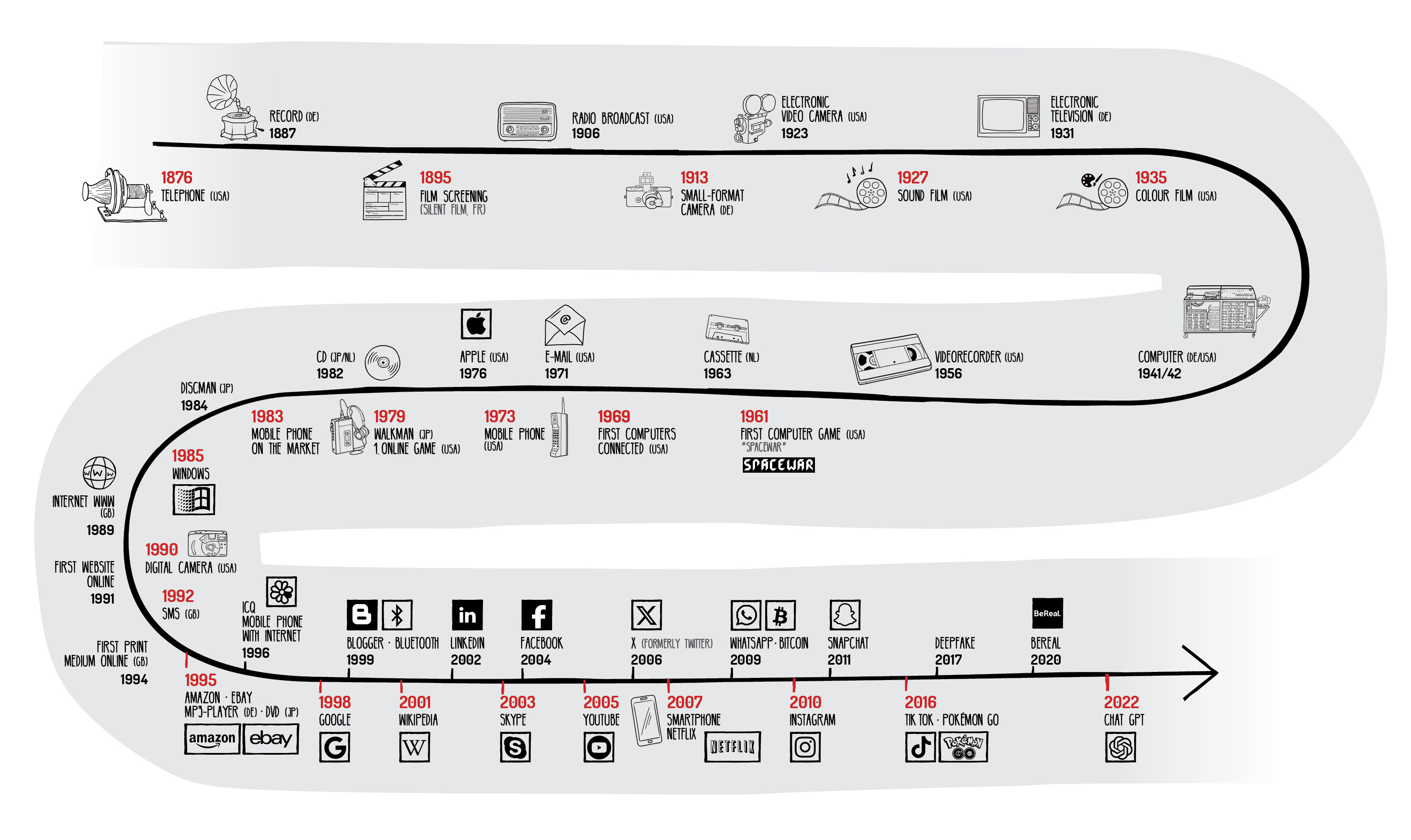
Having the world wide web in your pocket is still a relatively new phenomenon and parents along with teachers and caregivers are in the process of using and learning about dynamic technologies and at the same time recreating family life and education accordingly. Due to these dynamics parents have a high demand for orientation and guidance.
On the other hand, parents are already engaging in manifold ways to equip their kids for a digital future and have their own expertise to offer. They are no digital immigrants like generations before having grown up in a digital landscape and they are, depending on their resources, acting "as media mentors, brokers, co-learners, resource providers and more so as to help children develop the interests and values that may undergird their later pursuits and open up productive pathways to learning." Kindergartens can be places to open up cooperative learning processes and provide orientation.ⓘ
Some aspects to raise awareness among parents
- Media literacy - which skills are important, how can they support their child's media literacy?
- How can they establish a positive media culture at home and offer age appropriate access?
- Which rituals and routines are helpful at home to support children's development with digital media?
- How can they support a positive use of technology around communication and interaction?
- How are developmental steps in childhood linked to a balanced and conscious use of technology?
Are parents even interested?
How to create a welcoming environment for parents
Involving parents in a pedagogical setting can be tricky and even daunting to educators.
Why?
Teachers in kindergarten are primarily trained to work with children and not with adults. In addition the relationship between parents and teachers is not always clearly defined - are they partners, does one side support the other and are they open to learn from each other?
To kick off the development of this toolbox our partners conducted a small survey among kindergarten teachers in Croatia, Germany and Slovenia. 137 participants answered our questionnaire (56 Croatian, 47 German, 34 Slovene).
The most common channels are emails (55%), informational handouts or newsletters (50%), parent-teacher meetings (31%) and events linked to the children's activities (23%).
These quotes can be seen as examples of the problems that we face in parent-teacher relationships:
“Parents are not showing up for extra activities.”
“Parents do not want to be criticized.”
“Parents do not see educators in kindergarten as counterparts for problems at home (media use).”
How can teachers overcome these troubles in working with parents and lay the ground for an improved relationship? It is helpful to take into account their challenges and create a welcoming and positive atmosphere.
Limited time and energy
Parents are juggling work, household and caregiving - extra activities compete with many other priorities.
Do not want to be lectured
Adults learn best in a dialogue - not by being told what to do or what they are doing wrong.
Often overwhelmed and stressed
Balancing daily life with parenting can be exhausting - media education may feel like yet another demand.
Not all the same
Different biographical backgrounds, resources, parenting styles and languages - one approach does not fit all.
“The key to an inviting approach towards parents is first to meet them where they are - without judging them for their parenting style and their choices.”
It can be very helpful to think a bit more about which group of parents exactly you want to reach. It is difficult if not impossible to reach all parents with the same approach. Oftentimes educational facilities expect parents to set the same priorities and be open towards information that they conceive to be important. In reality families are not all fitting in one box. They are coming from very different backgrounds and differ in how they are raising children and how they see the role of the kindergarten.
Depending on education, financial situation, health and cultural background resources and interests can be other than what teachers assume. One mother might always be late to parent-teacher conferences but not out of disinterest but because she is taking care of a chronically ill relative and has a tight schedule. A constructive and professional attitude towards parents is to assume that they have a good reason for their behaviour instead of judging them.
One important starting point for a good relationship between teachers and parents and a culture of participation is to get to know each other. Asking questions rather than assuming or interpreting actions need openness, sometimes courage and time on both sides. Open spaces for communication are key to building a better understanding and relationships.
Reflection on working with parents
- Take a look at the parents in your facility - which differences do they have, what do they have in common? How do they deal with digital media?
- What is working well in your cooperation with parents?
- Which parents do you want to reach especially?
- Why would parents want to show up for events concerning digital media?
- How can you introduce yourself (and colleagues) as partners to deal with questions around digital media?
- Are parents asking you for advice? Why? Why not?
- Which messages are key for you, to send to parents concerning digital media?
- Do you think parents feel welcome in your facility? Why/why not?
- Do you have parents in your facility that could act as multipliers to other parents because they are very engaged and well connected?
Methods
- Case Example: Smartphone Ban in Kindergarten (how to initiate communication with parents)
- Persona Method - Learn more about parents
Printable materials
- Survey for Parents - The survey can be handed out as a printed version or linked to a QR Code
- Parents Persona — Examples
Step 4
Tools for learning spaces
What you will learn here
- How to choose a fitting setting and method
- Settings for interacting with parents
- Different methods for interacting with parents and children
In Step 3 you have gained insights into different methods to approach and include parents in your work on media education. In Step 4 we now introduce different ways to create learning spaces with these caretakers. We open up a variety of different settings and methods that you can choose from, depending on your resources, time, parents' needs and own preferences.
How do I choose the setting and method?
The methods that we provide here have been tested and approved by kindergarteners but still sometimes one does not fit all. You can either first think about the method or choose a setting - both can be combined in different ways.
For example: If you choose to work on a media diary with kids, including the parents (method) you could either talk to parents about it in individual conversations, in a meeting with all parents, in a chat group or other settings.
4 tips to help you choose a setting and method that fits your requirements
Build on positive experiences
Settings that you have tried out and are working well with parents.
Very limited time?
Choose simple and small methods and go from there.
Give new ways time
New forms of interaction need time to be received and accepted by parents.
Repetition is key
Repeating activities helps build new rituals with parents.
Hopefully you find some ideas and methods that work in your facility and become part of its pedagogical repertoire.
Different settings for interacting with parents (and kids)
Media Literacy Settings for Work with Parents
Individual
Parent-teacher meetings
Family café
Working group
Parties / festivities
Presentation / theatre
Themed input
Interactive project
Chat group
Different methods for interacting with parents and kids
Here you can find a collection of methods for your work with parents:
All activities that are used with the kids in kindergarten could also be presented to the parents (pictures, play, documentation) - documenting the learning process.