
 Method Role-Play with Kids: Switch the Roles!Children and parents switch roles in common media-related situations |
||
2026 media.eduskills.plus |


Overview
-
Target group:Parents, Children
-
Group size:Small group
-
Duration:30–45 min
-
Materials:
- Scenario cards
- Simple props — remote control, phone, blanket, tableware, etc. (optional)
Goal
To promote empathy and mutual understanding between parents and children around media habits and daily routines.
Steps
Invite parents and children to participate in short role-plays where they switch roles: the child becomes the parent, and the parent acts as the child.
Explain that this is a playful and safe activity where everyone can explore everyday situations in a new way.
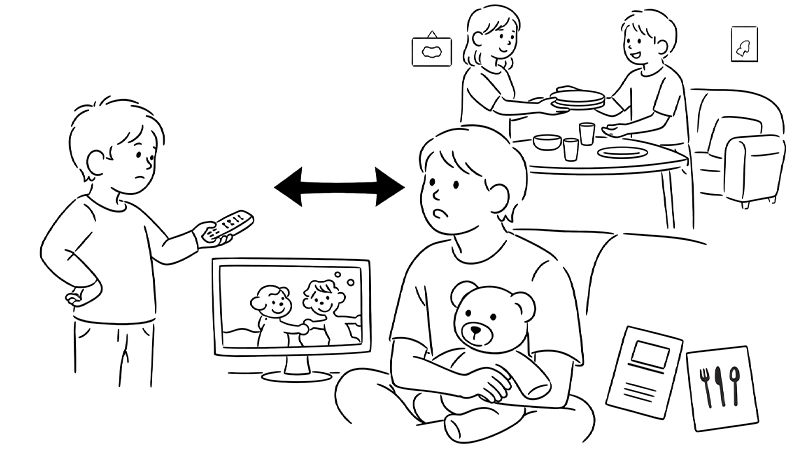
Present a scenario card (e.g. "The 'child' is watching TV, and the 'parent' asks them to turn it off and help set the table"). You could act out a scenario together with another teacher to break the ice.
Let the pairs act out the situation, improvising naturally. Encourage humor and creativity.
After each role-play, lead a light group reflection:
- How did it feel to switch roles?
- What was surprising or funny?
- Did this help you understand something new about each other?
Repeat with other pairs and scenarios. If time allows, try a "replay" with different responses.
Emphasize that the goal is not to judge behavior, but to learn from each other and talk openly about routines, rules, and feelings.