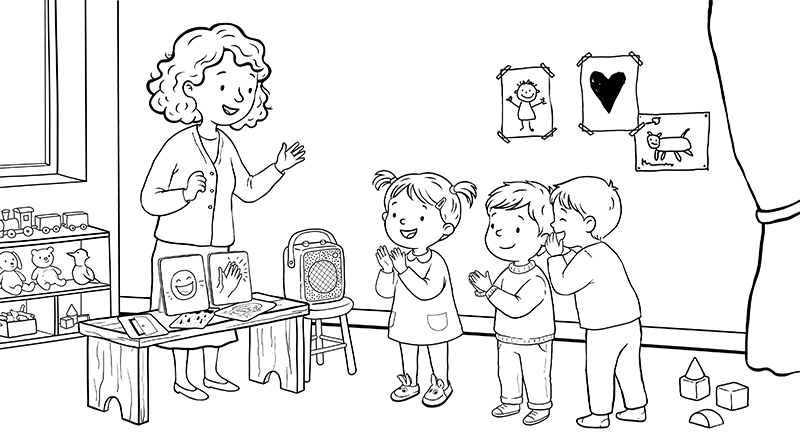
Listening, Imagining, and Feeling Through Sound
Children listen to different sounds and imagine what is happening, connecting sound with emotion.
Gather children in a circle and explain that they will listen carefully to different sounds and guess what might be happening.
Play one short audio clip (e.g. laughing, rain, a door creaking).
Ask: "What do you think is happening?" and "How does it make you feel?"
Encourage children to describe the scene or emotion connected to the sound.
Invite them to draw what they imagined, or act it out with movements and facial expressions.
Discuss the different interpretations and highlight that sounds can tell stories even without pictures or words.
Let children record their own sounds and create a "sound story."
Mix real sounds with imaginary or funny ones and have children guess which are real.
Use musical instruments or objects (shaking paper, tapping blocks) to reproduce the sounds.
Combine sounds into a short "sound sequence" and ask children to tell the story they hear.
This activity introduces children to the expressive power of sound in media. By listening closely, they learn to connect sounds with feelings and events, developing both imagination and emotional understanding. Sound stories help build active listening skills, an essential part of media literacy, by encouraging children to focus, interpret, and share ideas. Discussing their reactions strengthens vocabulary for emotions and sensory experiences, while creative expression through drawing or acting enhances comprehension. The activity fosters curiosity and awareness of how sound influences the way we perceive stories and moods in media.

Finanțat de Uniunea Europeană. Punctele de vedere și opiniile exprimate aparțin, însă, exclusiv autorului (autorilor) și nu reflectă neapărat punctele de vedere și opiniile Uniunii Europene sau ale Agenției Executive Europene pentru Educație și Cultură (EACEA). Nici Uniunea Europeană și nici EACEA nu pot fi considerate răspunzătoare pentru acestea.

Toate conținuturile, în special textele, imaginile și grafica, sunt protejate de drepturi de autor. Cu excepția cazului în care se specifică altfel, drepturile de autor sunt deținute de media.eduskills.plus și sunt licențiate în conformitate cu Creative Commons Attribution - Attribution-ShareAlike 4.0 International. Acestea pot fi utilizate în condițiile licenței.
© 2020-2026 media.eduskills.plus | Impressum