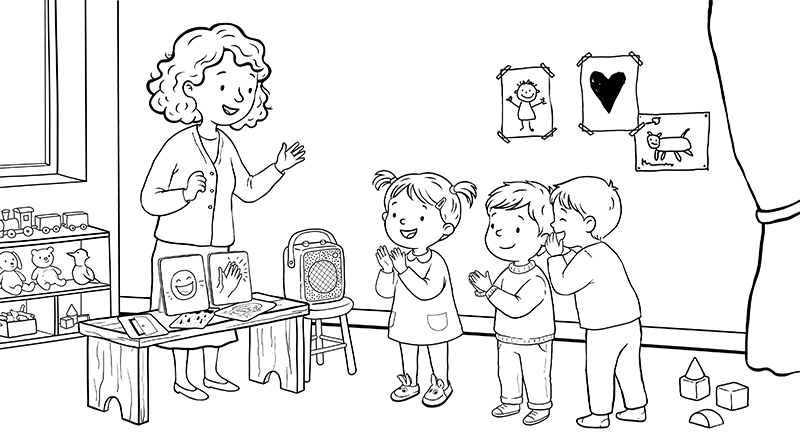
Hören, Vorstellen und Fühlen durch Klang
Kinder hören verschiedene Geräusche und stellen sich vor, was passiert, und verbinden Klänge mit Emotionen.
Die Kinder sitzen im Kreis, und es wird erklärt, dass sie aufmerksam verschiedene Geräusche anhören und erraten sollen, was passieren könnte.
Ein kurzer Audioclip wird abgespielt (z.B. Lachen, Regen oder eine knarrende Tür).
Fragen stellen: "Was glaubt ihr, passiert gerade?" und "Wie fühlt ihr euch dabei?"
Die Kinder werden ermutigt, die Szene oder das Gefühl zu beschreiben, das sie mit dem Geräusch verbinden.
Anschließend können sie zeichnen, was sie sich vorgestellt haben, oder es mit Bewegungen und Gesichtsausdrücken darstellen.
Zum Abschluss werden die unterschiedlichen Interpretationen besprochen, und es wird hervorgehoben, dass Geräusche auch ohne Bilder oder Worte Geschichten erzählen können.
Kinder eigene Geräusche aufnehmen lassen und eine "Klanggeschichte" gestalten.
Reale Geräusche mit erfundenen oder lustigen Geräuschen mischen und raten lassen, welche echt sind.
Musikinstrumente oder Alltagsgegenstände (Papier schütteln, Bauklötze klopfen) verwenden, um Geräusche nachzustellen.
Mehrere Geräusche zu einer kurzen "Klangsequenz" kombinieren und die Kinder die gehörte Geschichte erzählen lassen.
Diese Aktivität führt Kinder an die Ausdruckskraft von Klang in Medien heran. Durch genaues Zuhören lernen sie, Geräusche mit Gefühlen und Ereignissen zu verknüpfen, und entwickeln sowohl Fantasie als auch emotionales Verständnis. Klanggeschichten fördern aktives Zuhören – eine zentrale Kompetenz der Medienbildung – indem Kinder lernen, sich zu konzentrieren, zu interpretieren und ihre Gedanken zu teilen. Das Besprechen ihrer Eindrücke erweitert den Wortschatz zu Emotionen und Sinneserfahrungen, während kreativer Ausdruck durch Zeichnen oder Darstellen das Verständnis vertieft. Die Aktivität stärkt Neugier und Bewusstsein dafür, wie Klang unsere Wahrnehmung von Geschichten und Stimmungen in Medien beeinflusst.

Von der Europäischen Union finanziert. Die geäußerten Ansichten und Meinungen entsprechen jedoch ausschließlich denen des Autors bzw. der Autoren und spiegeln nicht zwingend die der Europäischen Union oder der Europäischen Exekutivagentur für Bildung und Kultur (EACEA) wider. Weder die Europäische Union noch die EACEA können dafür verantwortlich gemacht werden.

Alle Inhalte, insbesondere Texte, Bilder und Grafiken sind urheberrechtlich geschützt. Soweit es nicht ausdrücklich anders gekennzeichnet ist, liegen die Urheberrechte bei media.eduskills.plus und stehen unter der Creative Commons Attribution - Attribution-ShareAlike 4.0 International. Sie dürfen im Rahmen der Lizenzbedingungen verwendet werden.
© 2020-2026 media.eduskills.plus | Impressum