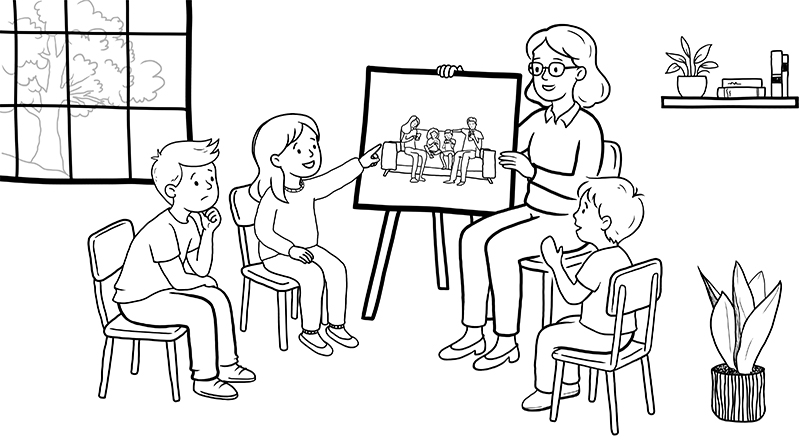
Diskussion auf Basis eines Bildes
Kinder betrachten ein Bild zur Bildschirmnutzung und sprechen über Gefühle, Gewohnheiten und mögliche Auswirkungen der Nutzung elektronischer Medien.
Die Kita-Fachkraft zeigt dem Kind ein Bild, das die Nutzung von Bildschirmen oder elektronischen Medien veranschaulicht.
Die Kita-Fachkraft stellt dem Kind Fragen, zum Beispiel:
Das Kind beantwortet die Fragen, und die Kita-Fachkraft schreibt die Antworten des Kindes auf.
Die Kita Fachkraft erklärt dem Kind die positiven und negativen Aspekte der Bildschirmnutzung.
Bilder und Fotografien können in Büchern, Zeitschriften, Zeitungen, im Internet gefunden oder mithilfe künstlicher Intelligenz erstellt werden (zum Beispiel ChatGPT, Bard, MyAI, Stable Diffusion). Die Bilder können humorvoll, comicartig, tierbezogen oder realistisch sein.
Die Antworten der Kinder können den Eltern bei Elternabenden präsentiert werden.
Auch ein Workshop mit Eltern unter Verwendung ähnlicher Bilder kann organisiert werden.
Diese Aktivität nutzt visuelle Beobachtung und angeleitete Gespräche, um frühe Medienreflexion zu fördern. Indem Kinder ein Bild besprechen und nicht direkt ihr eigenes Verhalten, können sie freier reflektieren und ihre Gedanken, Erfahrungen und Gefühle zur Bildschirmnutzung ausdrücken. Die offenen Fragen fördern kritisches Denken, Sprachentwicklung und emotionalen Ausdruck, ohne zu bewerten oder Regeln vorzugeben. Die Aktivität unterstützt ein ausgewogenes, altersgerechtes Verständnis von Mediennutzung und stärkt die Fähigkeit der Kinder, über alltägliche Medienerfahrungen zu sprechen.
Kinder sagten:

Von der Europäischen Union finanziert. Die geäußerten Ansichten und Meinungen entsprechen jedoch ausschließlich denen des Autors bzw. der Autoren und spiegeln nicht zwingend die der Europäischen Union oder der Europäischen Exekutivagentur für Bildung und Kultur (EACEA) wider. Weder die Europäische Union noch die EACEA können dafür verantwortlich gemacht werden.

Alle Inhalte, insbesondere Texte, Bilder und Grafiken sind urheberrechtlich geschützt. Soweit es nicht ausdrücklich anders gekennzeichnet ist, liegen die Urheberrechte bei media.eduskills.plus und stehen unter der Creative Commons Attribution - Attribution-ShareAlike 4.0 International. Sie dürfen im Rahmen der Lizenzbedingungen verwendet werden.
© 2020-2026 media.eduskills.plus | Impressum