Discovering the Creator's Message Behind a Story
Children learn that every story is created by someone with an idea or message to share.
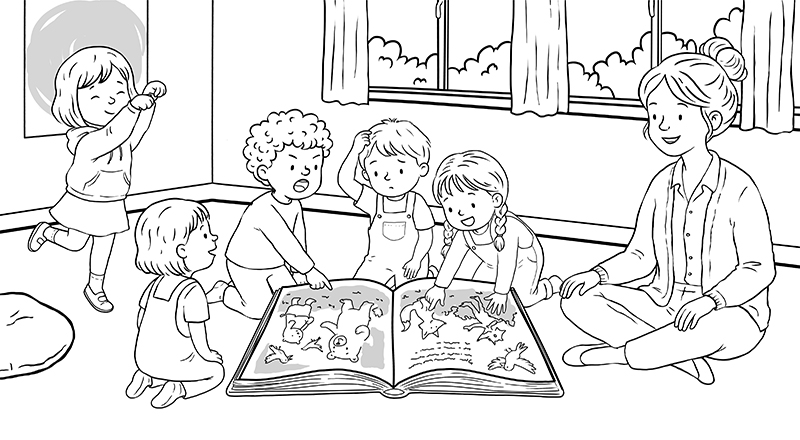
Read a picture book aloud to the group, showing the illustrations clearly.
After reading, ask questions such as:
Encourage children to think about the author and illustrator as real people who decide what happens in the story.
Invite children to share their ideas and feelings about the story's message.
As a follow-up, let them draw their favourite part or how they would change the ending.
Compare two picture books with different messages (e.g. one about family, one about friendship).
Invite children to "be the author" and invent a short story of their own.
Use puppets to act out the story.
This activity fosters early awareness that media and stories are created by people who choose how to present ideas and messages. By analyzing a familiar format — a storybook — children begin to understand that stories reflect intentions and values. Asking questions about authorship, motivation, and meaning encourages reflection and critical engagement with media content. It develops empathy by prompting children to consider different perspectives and prepares them to question other media they encounter. The combination of listening, discussion, and creative expression supports both cognitive and emotional learning.

Funded by the European Union. Views and opinions expressed are however those of the author(s) only and do not necessarily reflect those of the European Union or the European Education and Culture Executive Agency (EACEA). Neither the European Union nor EACEA can be held responsible for them.

All contents, in particular texts, pictures and graphics, are protected by copyright. Unless expressly stated otherwise, copyright is held by media.eduskills.plus and is licensed under Creative Commons Attribution - Attribution-ShareAlike 4.0 International. They may be subject to the terms of the license.
© 2020-2026 media.eduskills.plus | Impressum