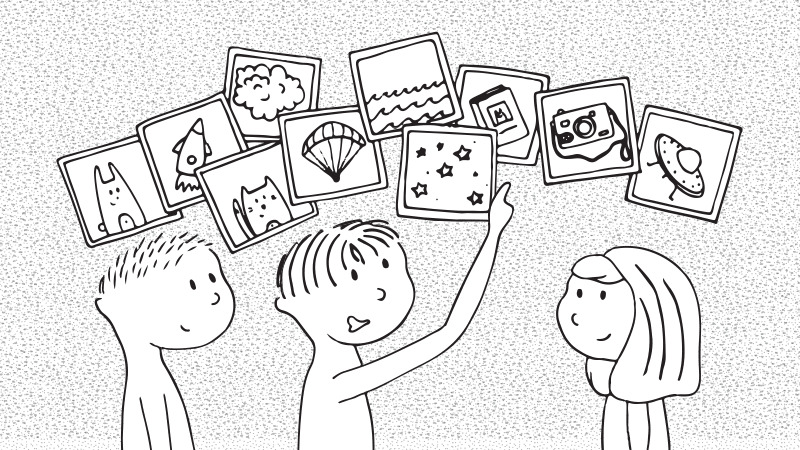
Children Find Their Stories
This activity helps children create and tell visual stories with the help of photography. In all this, the sequence of photographs is essential, as they dictate the development and course of the story.
Gather the children in a common space. Present your photo-story to children – show them the pictures and tell the accompanying story you have prepared. Then, explain to the children that they will prepare their photo-story. They make photographs which will be the basis for their very own story. Make sure that the children have understood the aim and the meaning of the upcoming activity.
Go with the children to a selected outdoor area where you then distribute cameras to the participants. Every child should capture interesting images that will be used for storytelling. Unobtrusively, try to direct the flow of the children’s creative process. The motives should be interesting and diverse. When you decide that the children have run out of creative concentration, gather in a common space to carry out the following steps. First, record the authorship of the photos, save them to your computer in the appropriate files. Then, review the photographic material with each child and together pick the photographs that you think stand out. Print the selection and give the photos to their respective authors.
The last step consists of the child telling a story through their photographs. During this process, encourage the child to talk about his or her impressions on the creative process and the meaning of the completed activity.
In case of bad weather, you may carry out the activity inside: playroom, changing room, canteen, etc. The present activity improves concentration in the creative process and also lets the child form a logical sequence out of separate elements – the jigsaw principle.
This activity may also form the basis for understanding the principle of animation. You can conduct this activity as a preparation for other activities involving animation.
All children like to listen to fairy tales and similar types of stories and our experience is that they also like to create such stories and thus build rich imaginary worlds. Some children, however, need some encouragement to articulate their thoughts optimally. The basic goal of the present activity is that each participant finds and enforces his or her way of narrative communication.
Most children had no difficulty describing emotional states in the various photographs. Some children, in addition to describing emotional states, also described their assumptions as to why the person in the photo is happy, sad, angry, scared. Many times, the children remembered how they felt at various events at home.
The children enjoyed both photographing a peer illustrating emotional states as well as the role of a model depicting emotional states. Children had a lot of photos (from the same day) and from all previous photographic activities. The photographs featured a variety of motifs of events and individual body parts, toys, objects, etc. Most of the children had no major problems describing and linking the events into a whole. The descriptions of the children differed in the use of the number of photographs in the narration. Language-savvy children used more than 6 photos and used multiple sentences next to one photo. Linguistically weaker children used fewer photographs and formed shorter sentences. During the activity, “photographers” and models laughed, inventing various body positions and grimaces on their faces.

Funded by the European Union. Views and opinions expressed are however those of the author(s) only and do not necessarily reflect those of the European Union or the European Education and Culture Executive Agency (EACEA). Neither the European Union nor EACEA can be held responsible for them.

All contents, in particular texts, pictures and graphics, are protected by copyright. Unless expressly stated otherwise, copyright is held by media.eduskills.plus and is licensed under Creative Commons Attribution - Attribution-ShareAlike 4.0 International. They may be subject to the terms of the license.
© 2020-2026 media.eduskills.plus | Impressum