
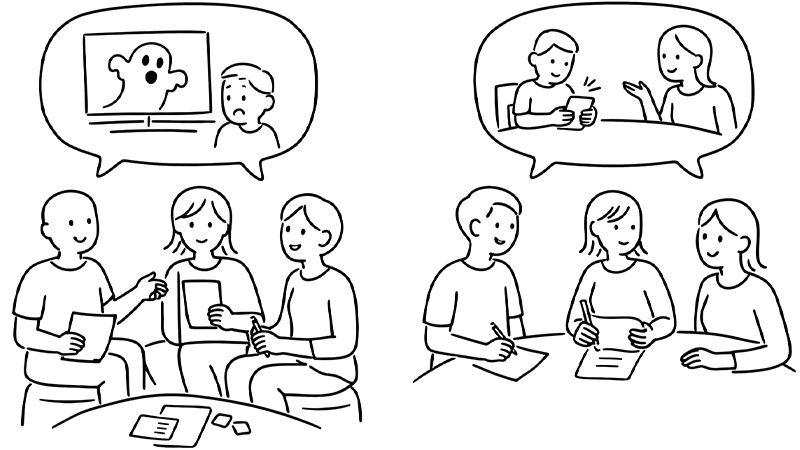
 Methode Was würdest du tun?Eltern bearbeiten reale Mediensituationen aus dem Familienalltag und diskutieren diese in Kleingruppen. |
||
2026 media.eduskills.plus |


Überblick
-
Zielgruppe:Eltern
-
Gruppengröße:Kleingruppe, Gruppe
-
Dauer:45+ Min.
-
Materialien:
- Ausgedruckte Fallbeispiele
- Stifte
- Papier
- Karten
- Flipchart
Ziel
Eine Diskussion mit Eltern über typische Herausforderungen rund um Mediennutzung in Familien eröffnen. Austausch und Interaktion anregen, Eltern zur Reflexion über ihre eigenen Ressourcen und Handlungsmöglichkeiten motivieren.
Schritte
Ein oder mehrere Fallbeispiele vorbereiten, die typische Konflikte rund um Mediennutzung in Familien zeigen. Alternativ können Eltern gebeten werden, eigene schwierige Situationen aus ihrem Familienalltag einzubringen.
- Das Kind sieht etwas Erschreckendes auf YouTube.
- Das Kind möchte beim Abendessen das Smartphone nicht weglegen.
- Thomas darf jeden Nachmittag vor dem Schlafengehen eine Folge schauen. Danach schreit und tobt er, weil er weiterschauen möchte.
Eltern in Gruppen einteilen oder sie selbst Gruppen bilden lassen (z.B. mit verschiedenfarbigen Bonbons oder Karten).
Jede Gruppe hat 20–30 Minuten Zeit, die Situation zu besprechen und Ideen zu sammeln, wie man damit umgehen kann. Leitfragen: Was passiert in dieser Situation? Was ist den Eltern in dieser Situation wichtig? Was ist für das Kind wichtig? Was könnte den Eltern in dieser Situation helfen? Was würdet ihr tun?
Ergebnisse anschließend im Plenum vorstellen und die zentralen Gedanken der Gruppen austauschen.
Ergänzend hilfreiche Ressourcen oder Informationsmaterialien vorstellen, die Eltern bei der Medienerziehung unterstützen können.