
Sound Story: What Do You Hear?
Listening, Imagining, and Feeling Through Sound
 Funded by the European Union. Views and opinions expressed are however those of the author(s) only and do not necessarily reflect those of the European Union or the European Education and Culture Executive Agency (EACEA). Neither the European Union nor EACEA can be held responsible for them. |
 All contents, in particular texts, pictures and graphics, are protected by copyright. Unless expressly stated otherwise, copyright is held by media.eduskills.plus and is licensed under Creative Commons Attribution - Non-commercial - Distribution under the same conditions 4.0 International license. They may be subject to the terms of the license. |
2026 media.eduskills.plus
Learning outcomes
Competencies
|
|
|
Target group 4 years and up
|
|
Required materials
|
|
| Materials |
Description of the activity (step by step)
Preparation:
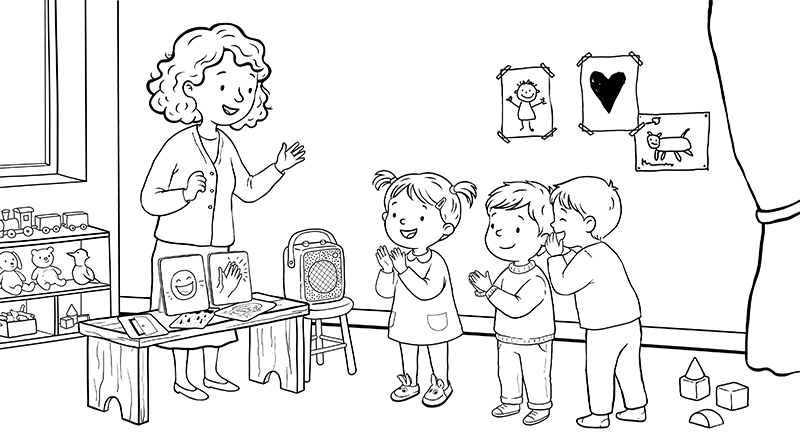
Gather children in a circle and explain that they will listen carefully to different sounds and guess what might be happening.
Implementation:
Play one short audio clip (e.g. laughing, rain, a door creaking).
Ask: "What do you think is happening?" and "How does it make you feel?"
Encourage children to describe the scene or emotion connected to the sound.
Invite them to draw what they imagined, or act it out with movements and facial expressions.
Reflection:
Discuss the different interpretations and highlight that sounds can tell stories even without pictures or words.
Variations and additional ideas
Let children record their own sounds and create a "sound story."
Mix real sounds with imaginary or funny ones and have children guess which are real.
Use musical instruments or objects (shaking paper, tapping blocks) to reproduce the sounds.
Combine sounds into a short "sound sequence" and ask children to tell the story they hear.
Background information and didactical perspective
This activity introduces children to the expressive power of sound in media. By listening closely, they learn to connect sounds with feelings and events, developing both imagination and emotional understanding. Sound stories help build active listening skills, an essential part of media literacy, by encouraging children to focus, interpret, and share ideas. Discussing their reactions strengthens vocabulary for emotions and sensory experiences, while creative expression through drawing or acting enhances comprehension. The activity fosters curiosity and awareness of how sound influences the way we perceive stories and moods in media.