
Media Sorting Game
Learning to Recognize and Sort Different Types of Media
 Rahastatud Euroopa Liidu poolt. Avaldatud seisukohad ja arvamused on ainult autori(te) omad ega pruugi kajastada Euroopa Liidu või Euroopa Hariduse ja Kultuuri Rakendusameti (EACEA) seisukohti ja arvamusi. Euroopa Liit ega EACEA nende eest ei vastuta. |
 Kogu sisu, eelkõige tekstid, pildid ja graafika, on kaitstud autoriõigusega. Kui ei ole sõnaselgelt teisiti märgitud, kuuluvad autoriõigused media.eduskills.plus ja on litsentseeritud Litsents: "Creative Commons Autorile viitamine – mittekaubanduslik - jagamine samadel tingimustel 4.0 Rahvusvaheline". Nende suhtes võivad kehtida litsentsitingimused. |
2026 media.eduskills.plus
Õpitulemused
tulemused
|
|
|
Sihtgrupp 3 aastat ja rohkem
|
|
Nõutavad materjalid
|
|
Materjalid
|
Tegevuse kirjeldus (samm-sammult)
Ettevalmistus:
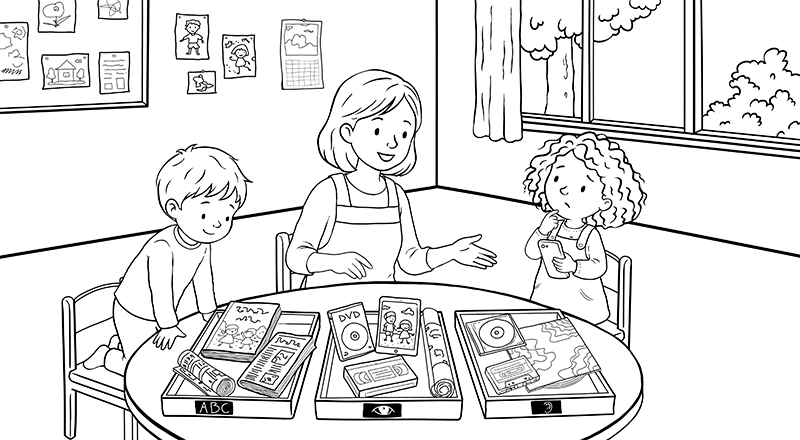
Gather children in a circle and show them different media items or pictures.
Briefly talk about each one: "What can we do with this? Can we read it, watch it, or listen to it?"
Introduce the sorting boxes or mats labelled with the three categories.
Tegevuse läbiviimine:
Invite children to take turns choosing an item and placing it in the correct category.
After sorting, review together and discuss: "Can a phone be used for watching or listening? What about books?"
Emphasize that media can have different purposes and we use them in various ways.
Variatsioonid ja lisaideed
Play a guessing game: describe an item and let children guess which box it belongs to.
Taustteave ja didaktiline perspektiiv
This activity helps children understand the diversity of media and their different uses. It builds foundational media literacy skills by developing the ability to distinguish between media formats and recognize their purposes (informing, entertaining, or educating). Through sorting and discussion, children practice observation and categorization, supporting early critical thinking. It also introduces vocabulary related to media (book, photo, video, sound) and opens a dialogue about how media influence our daily lives.