
Media Sorting Game
Learning to Recognize and Sort Different Types of Media
 Funded by the European Union. Views and opinions expressed are however those of the author(s) only and do not necessarily reflect those of the European Union or the European Education and Culture Executive Agency (EACEA). Neither the European Union nor EACEA can be held responsible for them. |
 All contents, in particular texts, pictures and graphics, are protected by copyright. Unless expressly stated otherwise, copyright is held by media.eduskills.plus and is licensed under Creative Commons Attribution - Non-commercial - Distribution under the same conditions 4.0 International license. They may be subject to the terms of the license. |
2026 media.eduskills.plus
Learning outcomes
Competencies
|
|
|
Target group 3 years and up
|
|
Required materials
|
|
Materials
|
Description of the activity (step by step)
Preparation:
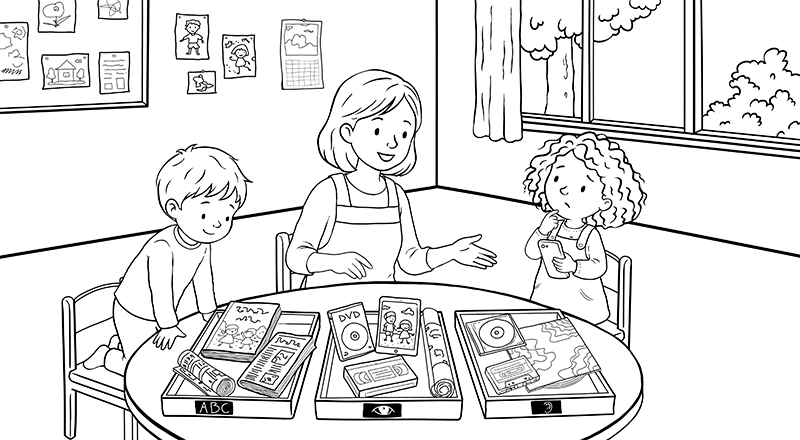
Gather children in a circle and show them different media items or pictures.
Briefly talk about each one: "What can we do with this? Can we read it, watch it, or listen to it?"
Introduce the sorting boxes or mats labelled with the three categories.
Implementation:
Invite children to take turns choosing an item and placing it in the correct category.
After sorting, review together and discuss: "Can a phone be used for watching or listening? What about books?"
Emphasize that media can have different purposes and we use them in various ways.
Variations and additional ideas
Play a guessing game: describe an item and let children guess which box it belongs to.
Background information and didactical perspective
This activity helps children understand the diversity of media and their different uses. It builds foundational media literacy skills by developing the ability to distinguish between media formats and recognize their purposes (informing, entertaining, or educating). Through sorting and discussion, children practice observation and categorization, supporting early critical thinking. It also introduces vocabulary related to media (book, photo, video, sound) and opens a dialogue about how media influence our daily lives.