Use of Screens / Electronic Media
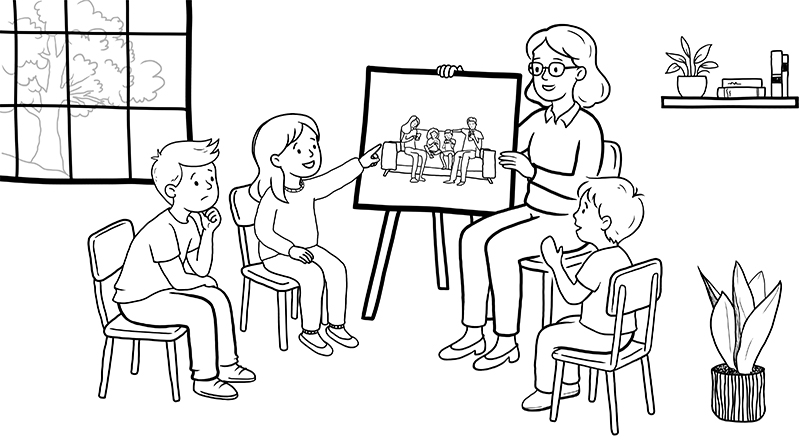
Discussion Based on an Image
 Rahastatud Euroopa Liidu poolt. Avaldatud seisukohad ja arvamused on ainult autori(te) omad ega pruugi kajastada Euroopa Liidu või Euroopa Hariduse ja Kultuuri Rakendusameti (EACEA) seisukohti ja arvamusi. Euroopa Liit ega EACEA nende eest ei vastuta. |
 Kogu sisu, eelkõige tekstid, pildid ja graafika, on kaitstud autoriõigusega. Kui ei ole sõnaselgelt teisiti märgitud, kuuluvad autoriõigused media.eduskills.plus ja on litsentseeritud Litsents: "Creative Commons Autorile viitamine – mittekaubanduslik - jagamine samadel tingimustel 4.0 Rahvusvaheline". Nende suhtes võivad kehtida litsentsitingimused. |
2026 media.eduskills.plus
Õpitulemused
tulemused
|
|
|
Sihtgrupp 5 aastat ja rohkem
|
|
Nõutavad materjalid
|
|
Materjalid
|
Tegevuse kirjeldus (samm-sammult)
Ettevalmistus:
The teacher shows the child an image that illustrates the use of screens or electronic media.
Tegevuse läbiviimine:
The teacher asks the child questions, such as:
- What do you see?
- What is in the picture?
- What is the boy/girl doing?
- What do you think the boy is watching on the phone?
- How do you think they feel while watching?
- Do you also have a phone or a tablet?
- What would you do if …?
- Do you think that …?
The child answers the questions, and the teacher writes down the child's responses.
Refleksioon
The teacher explains the positive and negative aspects of screen use to the child.
Variatsioonid ja lisaideed
Images and photographs can be found in books, magazines, newspapers, on the internet, or created with the help of artificial intelligence (for example ChatGPT, Bard, MyAI, Stable Diffusion). The images can be humorous, comic-style, animal-themed, or realistic.
Children's responses can be presented to parents at parent meetings.
A workshop with parents using similar images can also be organised.
Taustteave ja didaktiline perspektiiv
This activity uses visual observation and guided conversation to support early media awareness. By discussing an image rather than their own behaviour directly, children can reflect more freely and express their thoughts, experiences, and emotions related to screen use. The open-ended questions encourage critical thinking, language development, and emotional expression, while avoiding judgement or rules-based instruction. The activity promotes a balanced, age-appropriate understanding of media use and strengthens the child's ability to talk about everyday media experiences.
lasteaedade kogemused
Children said:
- The people in the pictures are only looking at screens, and we are not allowed to do that. It is not healthy for the eyes and you can become blind. At least the cat is not looking at a screen. They are texting friends, taking photos, and playing games. None of this is right. When my mum told me it is harmful, I turned it off and went to play with my sister Ana. At home, mum and dad look at their phones the most. Then I have to do everything by myself. I even have to sing a lullaby to Ana. That is why I am sleepy when I come to kindergarten.
- In the pictures everyone is looking at phones. We do not look at phones, we play. Sometimes I watch cartoons, sometimes it is forbidden. I can only watch two cartoons per day. A little screen time is okay, but too much is not.
- Everyone in the family looks at the phone and plays games. I can only use the phone when mum is not at home. Then I watch videos on YouTube. Mum does not allow it.
- People are looking at phones. They feel happy because they are at home. I have a phone and a computer, but they do not work, they are broken.
- The little sister is taking photos. Dad is working on the computer. The girl is drawing on a tablet. Mum is looking at her phone. The big sister is playing games on the television. The cat is sleeping here. It is not good that they are watching. It is not good to look at a phone all day, because your eyes hurt and you have to wear glasses. At home, mum and dad look at their phones. I watch cartoons on the phone.
Tööleht
Tegevuste pildid