Scenography for a Story
Minecraft
 Funded by the European Union. Views and opinions expressed are however those of the author(s) only and do not necessarily reflect those of the European Union or the European Education and Culture Executive Agency (EACEA). Neither the European Union nor EACEA can be held responsible for them. |
 All contents, in particular texts, pictures and graphics, are protected by copyright. Unless expressly stated otherwise, copyright is held by media.eduskills.plus and is licensed under Creative Commons Attribution - Non-commercial - Distribution under the same conditions 4.0 International license. They may be subject to the terms of the license. |
2026 media.eduskills.plus
Learning outcomes
Competencies
|
|
|
Target group 5 years and up
|
|
Required materials
|
Description of the activity (step by step)
Preparation:
Prepare the space with planned materials for creating scenography and props for filming.
Implementation:
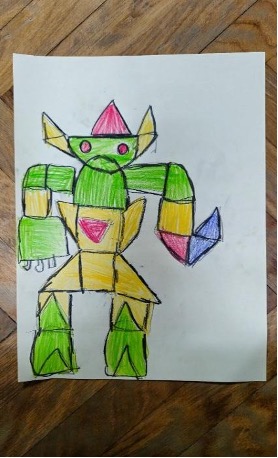
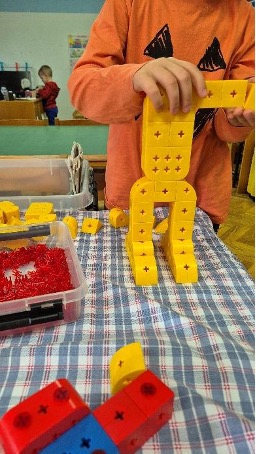
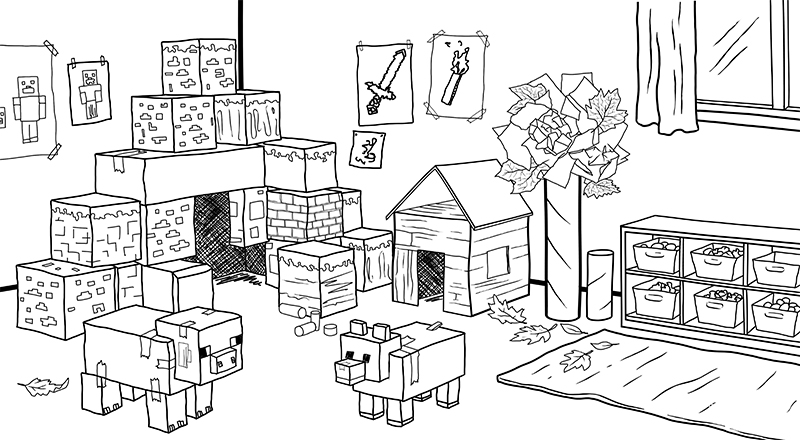
Gather the children and talk with them about the video game Minecraft. Encourage them to share their observations (for example, that the characters and objects are block-shaped).
Ask guiding questions:
- Which characters appear in Minecraft?
- What do they look like?
- What do they do?
- Where do they move and how?
- Are the characters in an open or closed space?
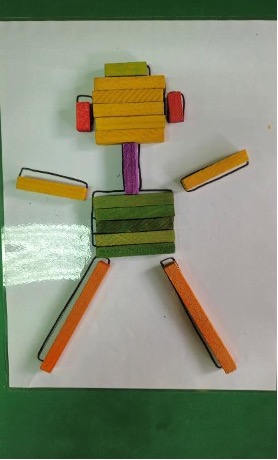
Write down the children's ideas. Invite them to create or draw Minecraft characters and to stage one scene from the game.
Ask further questions:
- What do you need to create the characters?
- Where should the characters be placed?
- How will you show this?
Suggest that they begin making the necessary props and scenography. Explain what props and scenography are, show examples, and clearly describe what scenography is and what it is used for.
Variations and additional ideas
Create and record an animated film using the stop-motion technique.
Background information and didactical perspective
Scenography for a story refers to the visual background, space, and atmosphere in which a story takes place. It includes elements such as the background, characters, props, furniture, and other objects. Scenography is created from different materials and adapted for each scene to support the story and create the desired visual effect.
Scenography helps establish atmosphere and supports understanding of where the characters are and what they are doing in each scene. It is important that all elements are movable and easy to manipulate.
This activity helps children understand how visual elements of scenography contribute to mood and meaning in a scene. The scenography workshop has strong integrative and creative value, as it connects visual expression, dramatic play, social learning, and spatial awareness, and supports children in verbalising their experiences and perceptions.
Experience from kindergartens
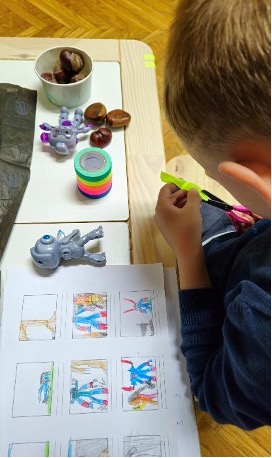
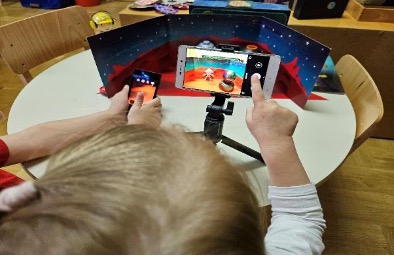
F. G. takes his storyboard and suggests to L. P.: "Let's film my movie about robots."
F. G. places PVC robot figures on the table. L. P. notices that they are missing props and says: "We'll need something black for the sky because it's night."
They bring different materials and PVC figures and agree on how to arrange the props in the scene.
L. P. comments: "This is what a stage in a theatre looks like, but it's not always the same. Different things change, like tables, sewing machines, lamps, and other objects."
E. P. adds: "In theatre, the background is sometimes black like it's night, but it was pink in one play. And in Aladdin, it's not always night, sometimes it's day."
The boys continue assembling the scene.
Photos of the activity