
Overhead Projector Exploration
A Story Told Through Light
 Finanțat de Uniunea Europeană. Punctele de vedere și opiniile exprimate aparțin, însă, exclusiv autorului (autorilor) și nu reflectă neapărat punctele de vedere și opiniile Uniunii Europene sau ale Agenției Executive Europene pentru Educație și Cultură (EACEA). Nici Uniunea Europeană și nici EACEA nu pot fi considerate răspunzătoare pentru acestea. |
 Toate conținuturile, în special textele, imaginile și grafica, sunt protejate de drepturi de autor. Cu excepția cazului în care se specifică altfel, drepturile de autor sunt deținute de media.eduskills.plus și sunt licențiate în conformitate cu Creative Commons Attribution - Necomercial - Distribuție în aceleași condiții 4.0 Licență internațională. Acestea pot fi utilizate în condițiile licenței. |
2026 media.eduskills.plus
Rezultatele învățării
Competențe
|
|
|
Grupul țintă 4 an și peste4 ani și mai în vârstă
|
|
Materiale necesare
|
Descrierea activității (pas cu pas)
Pregătire:
Prepare the room by setting out the planned materials and the overhead projector. Also prepare a familiar story that the children already know.
Implementare:
At the beginning of the activity, carry out one or two drama games with the children (for example Spider and Fly or Find a Pair) to help them relax and form groups.
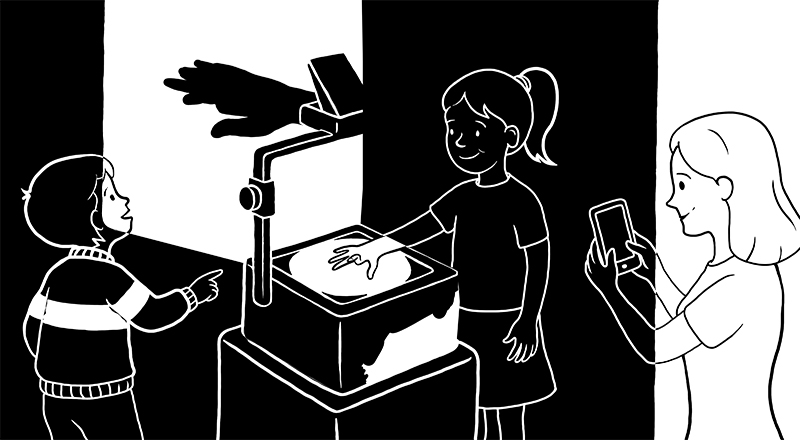
Then show the children how the overhead projector works and demonstrate the effects that can be created using the offered materials. Encourage the children to manipulate the materials and explore freely.
Gather the children in a circle and retell a familiar story. Afterwards, the children dramatise the story in groups using the overhead projector and the available materials.
Reflecţie:
Record the dramatization process, transfer the video to a computer, and watch the projection together with the children. Talk with them about their impressions of the created content.
Variații și idei suplimentare
The same workshop can be carried out with children and parents as a form of shared activity and socialising.
Informații generale și perspectivă didactică
Through play, children explore the relationships between light, materials, and space, developing creativity and imagination. In this way, they connect aesthetic expression with observation. Through free exploratory play with light and shadow, children spontaneously develop performative practices, as their actions, movements, and creations in space become forms of expression and communication.
The overhead projector is not only a projection tool, but a medium that introduces children to stage experience and visual creation. Children take on the roles of both researchers and performers. They decide which materials to place on the projector surface, how to move objects and their own bodies, and what kind of impression they create on the projection screen. This approach encourages aesthetic sensitivity, creativity, and cooperation, and helps children understand that art can emerge through play, exploration, and shared action.
Experience from kindergartens
K. P.: "I would make a performance about dinosaurs. Come on, turn on the overhead projector for us."
L. V.: "Can I also make a performance?"
Together, they prepare props (PVC dinosaur figures, coloured transparent foils, and other materials). Other children help prepare the space (chairs, screen, tickets for the performance, etc.). K. J. volunteers to record the performance.
After the performance, M. D., L. B., and K. J. want to photograph different figures on the overhead projector, while E. P. wants to create their own GIF using the light of the overhead projector.
K. J.: "The overhead projector is great! We can do so many things with it."
L. V.: "But we must not turn it on by ourselves."
M. D.: "We must not, because it is electricity, and electricity is dangerous."
K. J.: "On the overhead projector I can photograph that screen, Baby Lasagna (lace)."