
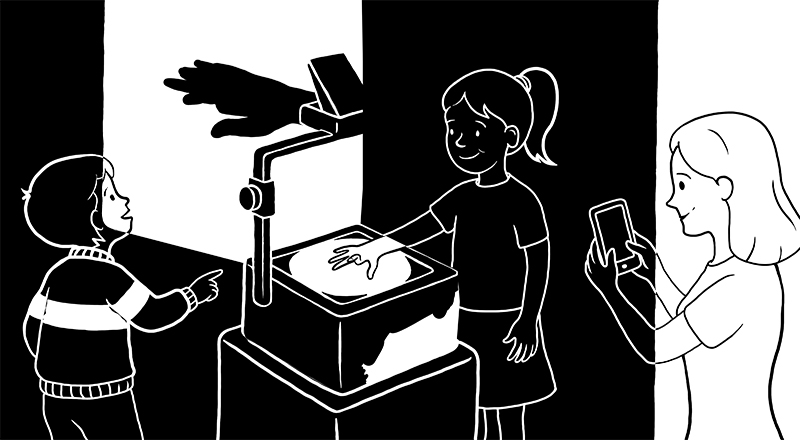
Overhead Projector Exploration
A Story Told Through Light
 Funded by the European Union. Views and opinions expressed are however those of the author(s) only and do not necessarily reflect those of the European Union or the European Education and Culture Executive Agency (EACEA). Neither the European Union nor EACEA can be held responsible for them. |
 All contents, in particular texts, pictures and graphics, are protected by copyright. Unless expressly stated otherwise, copyright is held by media.eduskills.plus and is licensed under Creative Commons Attribution - Non-commercial - Distribution under the same conditions 4.0 International license. They may be subject to the terms of the license. |
2026 media.eduskills.plus
Learning outcomes
Competencies
|
|
|
Target group 4 years and up
|
|
Required materials
|
Description of the activity (step by step)
Preparation:
Prepare the room by setting out the planned materials and the overhead projector. Also prepare a familiar story that the children already know.
Implementation:
At the beginning of the activity, carry out one or two drama games with the children (for example Spider and Fly or Find a Pair) to help them relax and form groups.
Then show the children how the overhead projector works and demonstrate the effects that can be created using the offered materials. Encourage the children to manipulate the materials and explore freely.
Gather the children in a circle and retell a familiar story. Afterwards, the children dramatise the story in groups using the overhead projector and the available materials.
Reflection:
Record the dramatization process, transfer the video to a computer, and watch the projection together with the children. Talk with them about their impressions of the created content.
Variations and additional ideas
The same workshop can be carried out with children and parents as a form of shared activity and socialising.
Background information and didactical perspective
Through play, children explore the relationships between light, materials, and space, developing creativity and imagination. In this way, they connect aesthetic expression with observation. Through free exploratory play with light and shadow, children spontaneously develop performative practices, as their actions, movements, and creations in space become forms of expression and communication.
The overhead projector is not only a projection tool, but a medium that introduces children to stage experience and visual creation. Children take on the roles of both researchers and performers. They decide which materials to place on the projector surface, how to move objects and their own bodies, and what kind of impression they create on the projection screen. This approach encourages aesthetic sensitivity, creativity, and cooperation, and helps children understand that art can emerge through play, exploration, and shared action.
Experience from kindergartens
K. P.: "I would make a performance about dinosaurs. Come on, turn on the overhead projector for us."
L. V.: "Can I also make a performance?"
Together, they prepare props (PVC dinosaur figures, coloured transparent foils, and other materials). Other children help prepare the space (chairs, screen, tickets for the performance, etc.). K. J. volunteers to record the performance.
After the performance, M. D., L. B., and K. J. want to photograph different figures on the overhead projector, while E. P. wants to create their own GIF using the light of the overhead projector.
K. J.: "The overhead projector is great! We can do so many things with it."
L. V.: "But we must not turn it on by ourselves."
M. D.: "We must not, because it is electricity, and electricity is dangerous."
K. J.: "On the overhead projector I can photograph that screen, Baby Lasagna (lace)."