Inventing a Story
Storytelling with Kamishibai Theatre
 Funded by the European Union. Views and opinions expressed are however those of the author(s) only and do not necessarily reflect those of the European Union or the European Education and Culture Executive Agency (EACEA). Neither the European Union nor EACEA can be held responsible for them. |
 All contents, in particular texts, pictures and graphics, are protected by copyright. Unless expressly stated otherwise, copyright is held by media.eduskills.plus and is licensed under Creative Commons Attribution - Non-commercial - Distribution under the same conditions 4.0 International license. They may be subject to the terms of the license. |
2026 media.eduskills.plus
Learning outcomes
Competencies
|
|
|
Target group 5 years and up
|
|
Required materials
|
|
Materials
|
Description of the activity (step by step)
Preparation:
The teacher offers the child visual materials, picture cards with different objects drawn on them (for example animals, vegetables, plants, vehicles, homes). The child is encouraged to choose five pictures and invent their own story based on them.
Implementation:
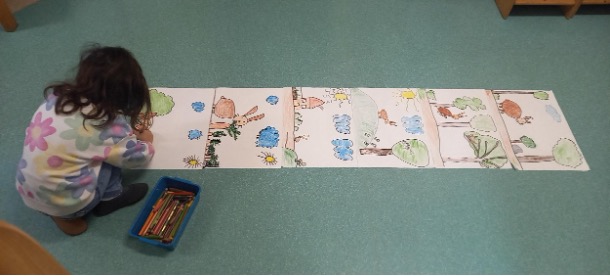
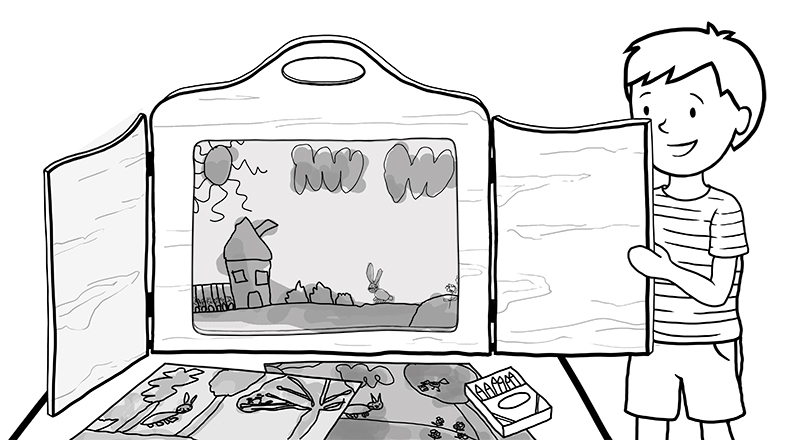
With the guidance of the teacher, the child invents events for each picture. The child forms meaningful sentences and connects them into a story. The story is illustrated through five consecutive events. The illustrations are placed into the Kamishibai theatre in the correct order. Using the illustrations, the child tells their invented story. The teacher records the storytelling.
Reflection:
The child watches their own storytelling recording. The teacher encourages reflection by asking:
- How did you feel while telling the story?
- Was it difficult?
- What did you like?
This is followed by feedback from the teacher:
- Was the speech loud and clear?
- How were the sentences formed?
- What could be added or changed?
Variations and additional ideas
Well-known literary stories can be used if children find it difficult to invent their own story.
Art materials and illustration techniques can vary.
The activity can also be carried out in pairs or small groups.
Background information and didactical perspective
This activity supports storytelling, creativity, and language development through visual prompts and structured narration. By choosing images and inventing a story sequence, children practise organising ideas, forming sentences, and connecting events into a coherent narrative. The Kamishibai theatre provides a clear visual framework that supports focus and confidence during storytelling.
Experience from kindergartens
The activity took place over a longer period of time (10 days). Children needed individual support in inventing a coherent story, mainly through guiding questions. They also needed support with illustrating the content, so that the drawings did not include too many details but focused on the essential elements. During recording, children had no difficulties, as they are used to recording themselves, watching the recordings, and reflecting on them.
Photos of the activity