
Bilderbuch-Analyse
Die Botschaft der Autorin oder des Autors hinter einer Geschichte entdecken
 Von der Europäischen Union finanziert. Die geäußerten Ansichten und Meinungen entsprechen jedoch ausschließlich denen des Autors bzw. der Autoren und spiegeln nicht zwingend die der Europäischen Union oder der Europäischen Exekutivagentur für Bildung und Kultur (EACEA) wider. Weder die Europäische Union noch die EACEA können dafür verantwortlich gemacht werden. |
 Alle Inhalte, insbesondere Texte, Bilder und Grafiken sind urheberrechtlich geschützt. Soweit es nicht ausdrücklich anders gekennzeichnet ist, liegen die Urheberrechte bei media.eduskills.plus und stehen unter der Creative Commons Namensnennung -Nicht kommerziell -Keine Bearbeitungen 4.0 International (CC BY-NC-ND 4.0) Lizenz. Sie dürfen im Rahmen der Lizenzbedingungen verwendet werden. |
2026 media.eduskills.plus
Lernergebnisse
Kompetenzen
|
|
|
Zielgruppe 5 Jahre und älter
|
|
Benötigte Materialien
|
Anleitung zur Aktivität (Schritt für Schritt)
Vorbereitung:
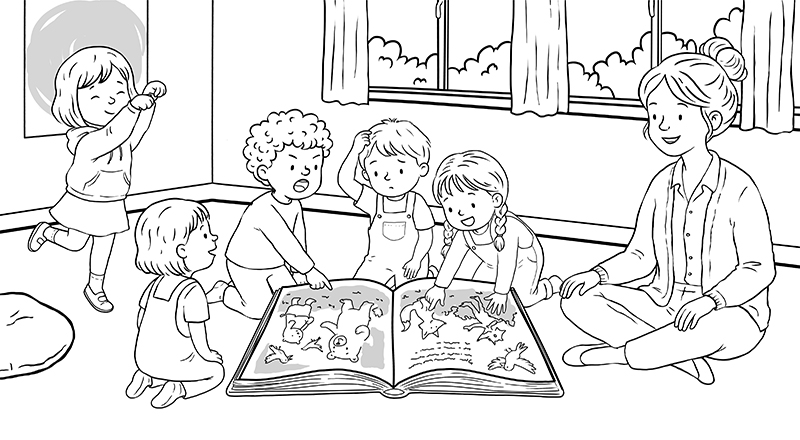
Das Bilderbuch wird der Gruppe vorgelesen, wobei die Illustrationen gut sichtbar gezeigt werden.
Durchführung:
Nach dem Vorlesen werden Fragen gestellt, zum Beispiel:
- Wer hat diese Geschichte gemacht?
- Warum glaubst du, wurde sie gemacht?
- Was möchte die Hauptfigur?
- Was können wir aus dieser Geschichte lernen?
Die Kinder werden ermutigt, darüber nachzudenken, dass Autor*in und Illustrator*in reale Personen sind, die entscheiden, was in der Geschichte passiert.
Die Kinder teilen ihre Ideen und Gefühle zur Botschaft der Geschichte.
Überlegung:
Als Anschlussaktivität können sie ihre Lieblingsszene zeichnen oder überlegen, wie sie das Ende der Geschichte verändern würden.
Abwandlungen und zusätzliche Ideen
Zwei Bilderbücher mit unterschiedlichen Botschaften vergleichen (z.B. eines über Familie, eines über Freundschaft).
Kinder einladen, selbst Autor*in zu sein und eine kurze Geschichte zu erfinden.
Die Geschichte mit Puppen nachspielen.
Hintergrundinformationen und didaktische Perspektiven
Diese Aktivität fördert ein frühes Bewusstsein dafür, dass Medien und Geschichten von Menschen gestaltet werden, die entscheiden, wie Ideen und Botschaften vermittelt werden. Durch die Analyse eines vertrauten Mediums – des Bilderbuchs – beginnen Kinder zu verstehen, dass Geschichten Absichten und Werte widerspiegeln. Fragen nach Urheberschaft, Motivation und Bedeutung regen zur Reflexion und zu einer kritischen Auseinandersetzung mit Medieninhalten an. Gleichzeitig wird Empathie gefördert, indem Kinder angeregt werden, unterschiedliche Perspektiven zu berücksichtigen, und bereitet sie darauf vor, auch andere Medien, denen sie begegnen, kritisch zu hinterfragen. Die Kombination aus Zuhören, Diskussion und kreativem Ausdruck unterstützt sowohl kognitives als auch emotionales Lernen.